Error Press Shutter Release Button Again D5300
Home Donate NewSearch Gallery Reviews How-To Books Links Workshops About Contact
Nikon D5300 Controls
© 2014 KenRockwell.com. All rights reserved.

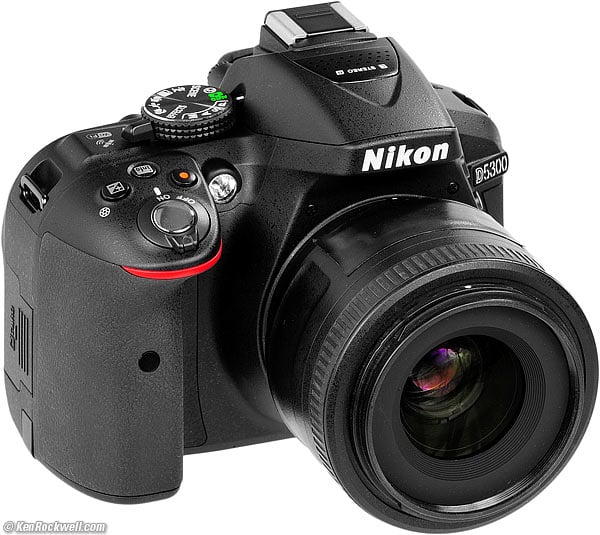
Nikon D5300 and 35/1.eight DX. overstate.
April 2014 Nikon D5300 Review Nikon Reviews Nikon Lens Reviews
Top of D5300 Guide
D5300 Guide Page Index
How to Set and Use the D5300'southward Autofocus Arrangement
Assistance me assist you elevation
I support my growing family unit through this website, as crazy every bit it might seem. My biggest source of support is when yous use any of these links, especially this link straight to the D5300 at Adorama or directly to the D5300 at Amazon, when you get anything, regardless of the country in which you alive. Thank you! Ken.
The biggest assist is when you utilise whatever of these links when you get anything, regardless of the state in which yous live. Information technology costs y'all nothing, and is this site'southward, and thus my family'due south, biggest source of support. These places have the best prices and service, which is why I've used them since earlier this website existed. I recommend them all personally.
If you find this folio as helpful as a volume you might have had to buy or a workshop you may have had to take, feel costless to aid me proceed helping everyone.
If you lot've gotten your gear through ane of my links or helped otherwise, you're family. It's great people similar y'all who allow me to proceed adding to this site full-time. Cheers!
If you lot haven't helped yet, please do, and consider helping me with a gift of $5.00.
Every bit this folio is copyrighted and formally registered, it is unlawful to make copies, especially in the form of printouts for personal use. If you wish to make a printout for personal utilize, you are granted one-time permission only if you lot PayPal me $5.00 per printout or part thereof. Thank you!
Thanks for reading!
Mr. & Mrs. Ken Rockwell, Ryan and Katie.Costless Alive Help (USA merely)
Desire gratuitous alive phone support?
In the USA, call (800) NIKON-UX.
Top Controls top of folio
Controls: Top Rear Side
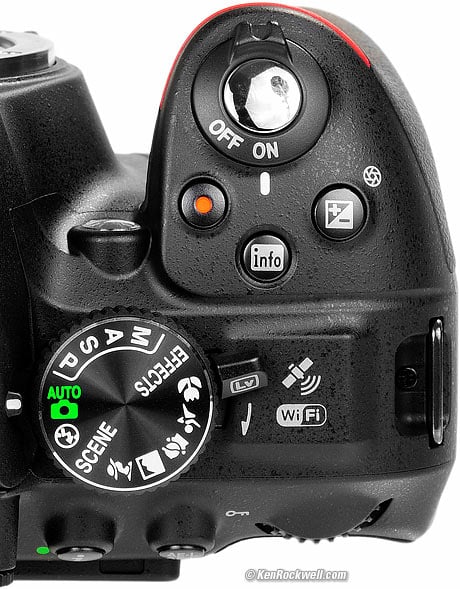
Peak, Nikon D5300.
OFF, ON and Shutter Release Button
Leave information technology ON unless you're putting it away. It draws no more ability in ON than OFF. OFF is only a lock to prevent adventitious operation when squashed in a case or luggage.
• Cherry-red Dot top
This starts and stops movies, but simply if you're in Live View.
INFO Push button top
If the D5300 is resting (LCD off), the INFO button wakes up the LCD and shows you the shooting info.
To alter these settings, use the < i > push.
If the LCD is showing Info (shutter speeds, etc.), the INFO push button turns off the brandish. Past comparison, the < i > push button also wakes the Info screen, simply if the Info screen is on, the < i > button allows you to change settings.
This sounds redundant, and it is; this INFO push button isn't actually needed.
+/- and Diaphragm (*) Button
This push button is to the lower right of the shutter button.
In manual exposure style, hold this and turn the rear dial to change the aperture.
In every other mode, concord information technology and plow the rear punch to change the brightness ("exposure compensation") of the next picture you lot take.
This exposure compensation button is very important. This button makes the photos lighter or darker. + is lighter, and - is darker.
This only affects photos as you take them. Use whatever setting looks best to you lot; there is no correct setting, although 0 is usually the best.
The exposure compensation button varies the exposure of everything. Nikon'south flash exposure is normally perfect. If y'all desire to modify the brightness of but the flash lone, printing and agree the flash button (on the left side of the wink hump) and the exposure compensation push button at the same time as you spin the rear dial.
HINT: You tin can see the + or minus value displayed in the finder every bit well as on the rear LCD, then yous can adapt this without taking your centre from the finder. The finder display simply shows the value as the push is held, otherwise those finder digits read something else.
Live View [LV] Lever top
Live View lets the rear LCD show the alive epitome before y'all shoot it. It's likewise the mode from which we tin shoot movies.
Pull this lever towards y'all to enter Live View mode.
Printing the Carmine Dot Button to commencement and terminate movies.
Exposure Way Selector Knob top
Spin it to select amidst P, South, A and G exposure modes.
I use the P (Professional) way. Only rarely do I use the S, A and Thousand Modes, and I never use any of the others.
I ignore the light-green Motorcar and all the other fluff modes. They are fluff and will not be discussed here. The fluff modes are for people not willing to read this guide as you lot are. The Machine mode can be useful if you get flustered and only need a picture fast.
Many of the menu options of which I speak elsewhere are only available in the P, S, A and M exposure modes.
P: Professional Automatic Exposure Style
I use "P," Professional, automatic exposure mode (formerly called "programme" in the 1980s). In this mode the camera chooses the f/stop and shutter speed for yous. Done.
The standard combinations are f/iv at ane/sixty, f/v.half dozen @ i/125, f/viii @ i/250, f/11 @ 1/500, and then forth.
It's piece of cake to get to any discontinuity or shutter speed you prefer in this style: simply motion the rear punch to shift them! This selects alternate combinations of f/stops and shutter speeds, all of which give exactly the same exposure. Nikon calls this "Program Shift." A *P symbol appears on the bottom left of the viewfinder, to the left of the shutter speed.
A shifted ready might use f/iv @ 1/1,000, f/5.6 @ 1/500, or might use f/iv @ ane/2, f/v.6 @ 1 sec., etc. Don't worry, only flick the rear dial until you go the combination y'all adopt.
Three easy ways to return to the standard programme combination are to:
1.) flip to a different mode and back to P, or
ii.) turn the D5300 off and back on, or
3.) Flick the rear dial until the viewfinder's P* symbol goes abroad.
A, S and M Modes
These modes let you choose a deliberate aperture or shutter speed, or both. I rarely, if ever use these older modes. A and South modes date from the 1970s, and the M mode dates from Nikon'southward first cameras or the 1940s.
In A (Aperture-preferred) or South (shutter-prefered), you selection that value, and the camera volition automatically pick the other value. I rarely use these; I shift the program instead.
If you lot want to set both the difficult manner, employ M, transmission, style. The best use of Manual mode is for when you want to be sure that the camera uses the same exposure for each of several shots, for instance, for snapping a series of shots to be stitched into a panorama subsequently.
In A or Southward mode you tin can only set one of the two values, because the photographic camera is setting the other one for you.
A Style: Aperture Priority
In A fashion y'all choose the Aperture, and the D5300 chooses the shutter speed.
S Mode: Shutter Priority
In S mode you gear up the Shutter, and the D5300 sets the aperture.
If the D5300 runs out of available apertures, you easily tin become nether or over exposure in South mode: watch that the D5300 tin select a correct aperture for your lighting.
M Manner: Manual Exposure
In Manual mode, you have to ready everything the difficult way.
No one uses this mode except in complex weather. Ignore old-timers who tell you lot you need Manual manner; they say that because that's the only manner cameras had back in the 1950s.
I look at the LCD to check exposure after I shoot a moving-picture show. You lot tin apply the bar graph in the finder - but why? If y'all wanted to practise that, use another manner and let the D5300 exercise the setting for you.
The rear dial sets the shutter speed in manual exposure. To set the aperture, hold the +/- (*) (diaphragm) button about the shutter while turning the rear dial.
Firmware Defect: When turned ON, Auto ISO remains active in Manual manner. I e'er turn off Motorcar ISO when I enter Manual Mode, otherwise Auto ISO changes the ISO and ruins whatever yous were hoping to accomplish with manual exposure mode.
Rear Controls elevation
Controls: Top Rear Side
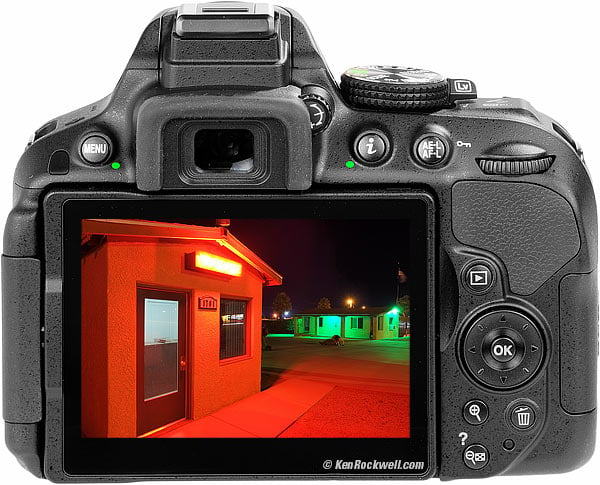
Rear, Nikon D5300. enlarge.
From meridian left to bottom right:
• Carte Push (summit left)
This gets you into the menus, as explained at the many menu pages beneath.
You also can set many shooting parameters with the i Button or Fn Button. They are different ways of setting exactly the same things; utilize whichever you prefer.
- <—> + Dial (behind tiptop correct of prophylactic eyepiece loving cup)
This adjusts the viewfinder to suit it to each person's eyesight.
Adjust it until your finder looks as sharp as possible to y'all. Each person may need a unlike setting.
• i Button (right side of eyepiece) tiptop
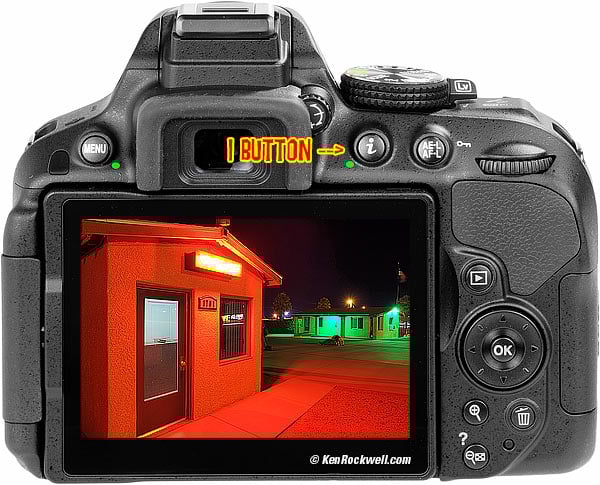
i button, Nikon D5300. overstate.
If the D5300 is resting (LCD off), the push wakes up the LCD and shows you the shooting info, called the INFO screen.
If the LCD is in the INFO mode (showing shutter speeds, etc.), printing the < i > button once again to change the settings along the right side and bottom of the screen. Apply the Up/Down/Left/Right/OK buttons.
RESET Role ( • • ) top
If you hold downwards the • MENU and • INFO buttons (the 2 with the green dots) at the same fourth dimension for a few seconds, you can quickly reset your D5300 to its bones settings. This is a big aid if you've messed with a agglomeration of settings, and simply want to get it dorsum to normal the next 24-hour interval.
Learn how your preferred settings vary from the default green-button reset values, and in only a few presses you will always be able to get your D5300 back to normal. I fix BASIC Small JPG instead of the default NORMAL Large and for landscapes I use VIVID Film Control, and that's it.
I usually practise this every forenoon. This prevents me from shooting all morning at last-night's tungsten white balance and ISO 6,400 settings that I may have used.
AE-L AF-50 ( Primal) Push button (top right) elevation
Shooting: AE-L AF-L.
This can lock the focus and/or exposure or turn on the autofocus.
You set its exact function past:
Carte du jour > CUSTOM (pencil) > f2 Assign AE-Fifty/AF-Fifty button.
I set mine to AE lock only.
Playback: Key.
Printing it to protect an image from deletion.
I don't practise this: formatting still erases everything anyway, and if "protected" images go far to your computer, information technology is very difficult to delete them or empty them from your trash.
Rear Dial (superlative right) top
Spin this left or right to control most of the D5300'southward functions.
While shooting, it unremarkably shifts the plan.
If you've striking the PLAY button, information technology steps forward or back through the images.
If an image pops on the screen correct later on shooting, a firmware defect prevents this dial from irresolute to different images until after you're pressed either the left or right push button. Instead, information technology shows the INFO screen.
This dial does null while in the menus.
[>] (Play) Push button pinnacle
This plays, or stops playing, an epitome.
Yous don't need this often, since the LCD turns off the instant you lot tap the shutter button, and if y'all set Image Review ON (MENU > PLAYBACK > Image review > ON > OK) it plays automatically later each shot.
With Prototype Review ON, you tin can do anything and everything to the image immediately afterward shooting without having to printing Play. Want to zoom, scroll, or see other images? Just move the appropriate controls.
The D5300 has a defect where the rear punch is ignored during review. If you lot desire to change to other images right later taking one, first tap the left or right button, then the dial works to permit you motility to other images.
Multi Selector
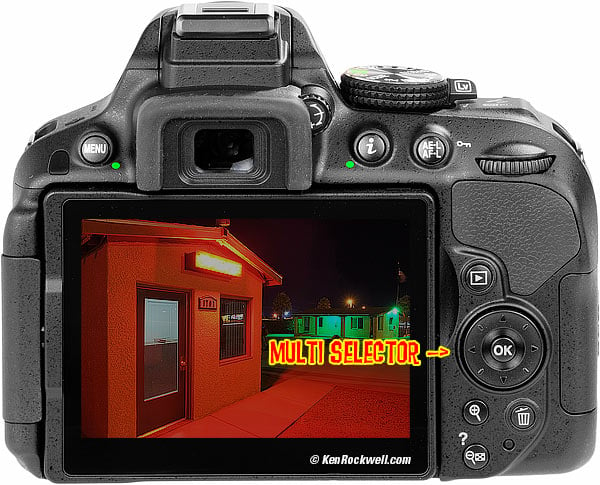
Rear Multi-Selector: the ring around "OK." overstate.
This is the big round eight-mode thumb switch with the OK in the middle.
While playing, this moves amid your images (left/right) and the information for them (upwardly/downwardly). I discover information technology more convenient to spin the rear dial to go frontward and back; try information technology.
When playing a zoomed prototype, it scrolls around the image, even diagonally.
While shooting, it selects among the AF areas if you're in a mode which allows you to select an AF area.
In the menus, it moves around your selections.
Green LED (beneath trash button) top
This calorie-free should be red, because information technology means the D5300 is talking to the SD memory card and you must non remove it. If you're dumb enough to yank out the carte with the light on, yous non only volition lose some photos, you may destroy your SD carte.
This usually blinks when the D5300 is turned on or off or wakes upwardly to shoot. It blinks for a moment after each shot to record information technology to the card. Information technology blinks every bit you select dissimilar playback images as it reads them from the card.
It can stay lit for a minute or more while data gets written, if y'all insist on shooting a lot of fast sequences in raw.
You may ignore it while shooting. You don't have to wait for it, except to pull out your SD menu. The D5300 has a large information buffer to let y'all shoot as fast equally yous want without having to wait for this light.
Zoom (+) Button top
This push button zooms-in when playing an image. Use the Multi Controller to scroll around.
Pull a fast one on: When zoomed in, flicking the rear dial will go forward/back among other images, all at the same zoom and location. (The Multi Controller still moves around inside the zoomed images.) This makes it easy to run into which shots in a sequence are sharp or not. The bad news is that when you delete i that the monitor returns to the default full-image view.
Improved from the D5200, y'all can use this punch when zoomed later on the paradigm pops upward afterwards taking a shot. No longer do you lot have to press the left or right button to become the D5300 in the mood, it just works after you've pressed (+).
Trash Can Button elevation
Printing it while a photo is displayed to erase that photo. You lot'll become an "are y'all certain?" screen, and press it again to dump that shot.
Meatheads like me go used to double pressing information technology every time out of habit, which means I accidentally erase some shots. Serves me correct.
Information technology doesn't do anything else. It ignores yous if pressed without an paradigm displayed.
(—) / ? / Checkerboard Button pinnacle
If playing, it reduces the images to fit 2 ten 2, three x iii, or a bunchload of images on the screen. If the prototype was zoomed, it zooms out.
If working in the menus, oftentimes this push button will give more than information about the setting at hand.
If the "?" is flashing in the bottom correct of the viewfinder, that ways you accept a message waiting from your D5300. Press the "?" push and your D5300 will tell you what's on its mind! It's usually telling you lot to turn on the flash.
Side Controls superlative
Controls: Tiptop Rear Side
+/- Lighting Bolt (Flash Mode) Button
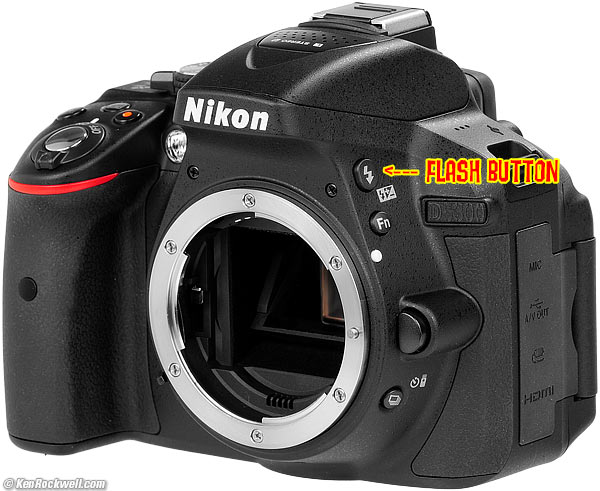
Flash Mode Button. enlarge.
This button does three things:
1.) Press in one case to pop upward the born wink.
2.) Hold information technology and the +/- (*) diaphragm push at the same time, so spin the rear dial to alter the effulgence of the flash for the next shot. This is much easier to do than it sounds.
0.0 is normal. I've never adjusted the flash separately from the primary exposure. Minus makes the flash darker, and plus side makes the flash lighter for the next shot.
3.) Concur information technology and spin the rear punch to select the wink sync mode. The sync mode is displayed on the lower left of the rear LCD.
Here are the flash modes and what they practise:
Normal (a lightning bolt, which is the default):
In Program and A exposure modes, the shutter won't stay open up longer than 1/lx second.
I ever apply Normal fashion and it looks keen.
In this mode you won't go blur indoors, but you lot may get black backgrounds. The best mode to avert night backgrounds with the D5300 is to use an external flash like the SB-400 and bounce information technology off the ceiling (flip it upwardly). I dearest the await of the bounced SB-400 external flash; you tin see a zillion examples at my baby Ryan Rockwell's website.
Unlike other Nikons, the D5300 doesn't take a custom role to cull a longer speed, like 1/8, in P and A exposure modes to lighten backgrounds indoors. You'll accept to utilise S or M fashion which takes more piece of work to setup. Y'all can use the Slow Sync mode below, but indoors or at night it oftentimes results in foolishly long speeds of up to xxx seconds, which lead to blur.
Carmine-Eye (commodities and eyeball icon)
I never use this.
It shines an obnoxious light in your subject field's eyes for a couple of seconds and and then releases the shutter.
If I set this mode past accident it bugs the heck out of me, because the camera doesn't get off until several seconds after I've pressed the shutter, just I have no idea why because I've ready no self timer!
Information technology doesn't practice much to reduce redeye, and redeye is rarely a problem with the D5300. Skip this mode.
Red-Heart SLOW (bolt, centre and SLOW icon)
This is the SLOW way and redeye. I don't use information technology for the same reason I don't utilise Redeye.
Boring (commodities and Tiresome icon)
Wearisome allows the camera in P and A exposure modes to brand long exposures in dim lite with flash. This lets the backgrounds look natural instead of inky black, but can lead to blurring if you or anything moves.
In daylight, exposure times are less than ane/sixty of a second anyhow, so SLOW does the same thing as NORMAL.
Nearly issues of National Geographic show many indoor shots made in this mode. The background exposes correctly, people may exist blurred, and a outburst of wink freezes them along with the blurry ghost images.
Normal and Dull do the aforementioned affair in S and 1000 exposure modes, since y'all or the camera may select any shutter speed in these modes, regardless of flash sync.
I unremarkably prefer to choose an exact slowest shutter speed in the One thousand or South exposure modes, because the Tedious flash fashion in P or A exposure modes can allow shutter speeds to become too long for condolement, oftentimes 30 full seconds.
If you use Auto ISO, ofttimes the photographic camera will jack upwardly the ISO and prevent slow speeds beneath what you've prepare as the slowest speed for Automobile ISO. If you need a tedious speed for a blur consequence and it'south non working, turn off Auto ISO (Carte > Camera icon > ISO sensitivity settings > Auto ISO sensitivity control > OFF.)
REAR (commodities and REAR icon)
Normally the wink goes off the instant the shutter opens. With long exposures and blurred ghost images you unremarkably get the ghost streaming out in front end of the subject. Think about it: if a car is driving, the flash goes off and freezes the subject, then the car moves frontward. You'll have a ghost prototype ahead of the automobile, which ordinarily looks stupid.
Select REAR mode to have the flash go off when the shutter closes. Now you'll have movement blurring behind the frozen flash paradigm.
REAR doesn't do annihilation noticeably different with brusque exposures, and then you'll want to use longer shutter speeds in SLOW REAR way adjacent:
SLOW REAR (bolt, Ho-hum and REAR icon)
This lets the D5300 brand long exposures to have advantage of rear sync in a higher place.
Once more if you use Auto ISO, you may have to turn it off (MENU > CAMERA icon > ISO sensitivity settings > Auto ISO sensitivity control > OF.) to go to slower speeds.
Fn (Office) Button top
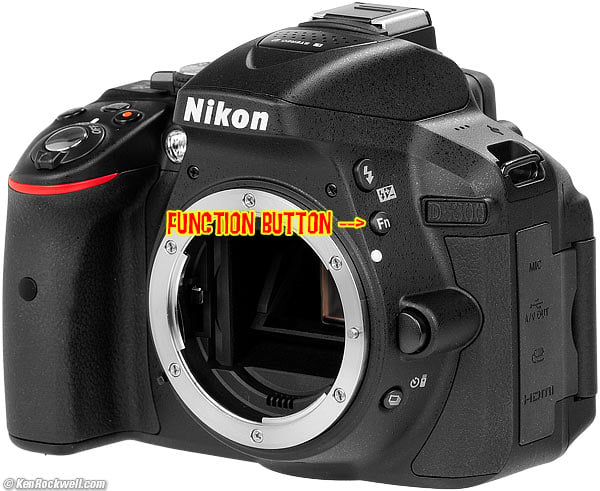
Office Button. enlarge.
By default, this lets you ready the HDR style.
Yous can ready it to do other things instead.
I adopt to gear up it for direct access to White Remainder.
To modify what it does, press:
Card > CUSTOM (pencil) > f1 Assign Fn button > select your choice > OK.
More at the CUSTOM SETTINGS carte.
Lens Release Push button top
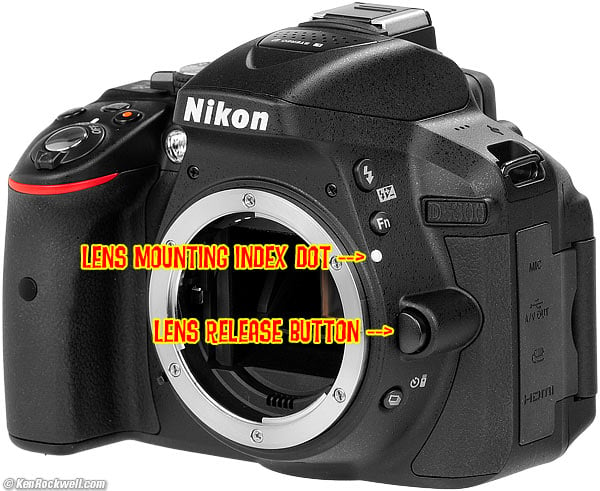
Lens Mounting and Release. overstate.
To mount a lens, align the dot on the lens with the index dot on the photographic camera, button-in the lens and turn until it locks with a click.
To remove a lens, push button-in the Lens Release push, rotate the lens, and pull information technology direct out.
Advance Mode Button (disguised rectangle) tiptop
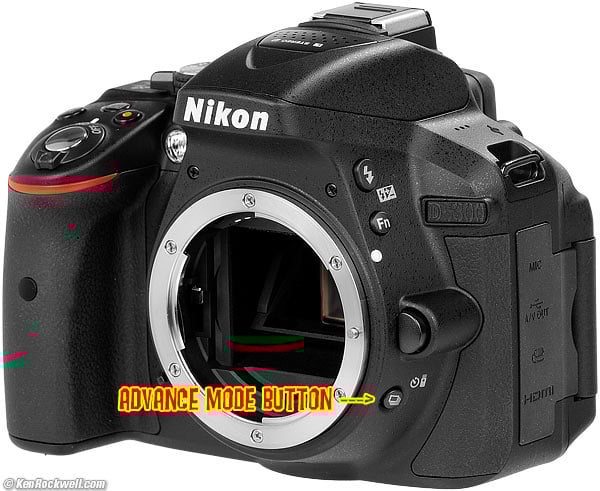
Advance Mode Button. enlarge.
This disguised rectangle button sets what the D5300 does when you agree down the shutter push. It likewise sets the self timer, the D5300'southward response to remote controls and the Serenity manner.
Hold this, look at the LCD and plow the rear dial to select these.
I explained which mode I use at the beginning, and accept more details about all the settings at the SHOOTING Menu.
back to top of page back to top of Nikon D5300 User's Guide
KNOBS, BUTTONS and CONTROLS
Autofocus System < Next
MENUS
PLAYBACK Card
SHOOTING Menu
CUSTOM SETTING Menu
SETUP MENU
RETOUCH Carte
Contempo SETTINGS Menu
NEW: Ken Rockwell's Nikon D5300 Users Guide app.
Dwelling house Donate NewSearch Gallery Reviews How-To Books Links Workshops Nearly Contact
pelletierthichise.blogspot.com
Source: https://www.kenrockwell.com/nikon/d5300/users-guide/controls.htm
0 Response to "Error Press Shutter Release Button Again D5300"
Post a Comment