During the Mycenaean Period Largescale Figural Art on the Greek Mainland Was
The Mycenaean civilization flourished in the late Bronze Age from the 15th to the 13th century BCE, and their artists would keep the traditions passed on to them from Minoan Crete. Pottery, frescoes, and goldwork skillfully depicted scenes from nature, religion, hunting, and war. Developing new forms and styles, Mycenaean art would prove to be more ambitious in calibration and range of materials than Cretan art and, with its progression towards more than and more abstract imagery, proceed to influence later Greek art in the Primitive and Classical periods.
Inspirations
The Mycenaean civilization was based on mainland Greece only ideas and materials came via trading contacts with other cultures across the Mediterranean. Imported materials included gold, ivory (principally from the Syrian elephant), copper, and glass, while in the other direction went Mycenaean goods such equally pottery to places as far afield equally Egypt, Mesopotamia, the Levant, Anatolia, Sicily, and Cyprus.
In art every bit expressed in fresco, pottery, and jewellery, the earlier Minoan culture on Crete profoundly influenced Mycenaean art. The Minoan honey of natural forms and flowing pattern peculiarly was adopted past Mycenaean artisans but with a tendency to more schematic and less life-like representation. This new style would go the ascendant 1 throughout the Mediterranean. Geometric designs were pop, too, equally were decorative motifs such every bit spirals and rosettes. Pottery shapes are much like the Minoan with the notable additions of the goblet and the alabastron (squat jar) with a definite preference for large jars. Terracotta figurines of animals and especially standing female person figures were pop, equally were small sculptures in ivory, carved stone vessels, and intricate gold jewellery. Frescoes depicted plants, griffins, lions, balderdash-leaping, boxing scenes, warriors, chariots, figure-of-eight shields, and boar hunts, a peculiarly pop Mycenaean activity.
Mycenaean artisans displayed a trend to more schematic & less life-like representation than seen in Minoan fine art.
Mycenaean Pottery
Early bike-made Mycenaean pottery from mainland Hellenic republic has been described as 'provincial Cretan' which does convey the fact that although shapes and decorative styles were of Cretan origin, the last ornamentation was not quite every bit finely executed as in Minoan centres such as Knossos and Phaistos. Mycenaean clay was often superior in quality to Minoan, though, and was fired at higher temperatures. Some dirt vessels were tin can-plated too, perhaps to imitate more costly silver and bronze wares.
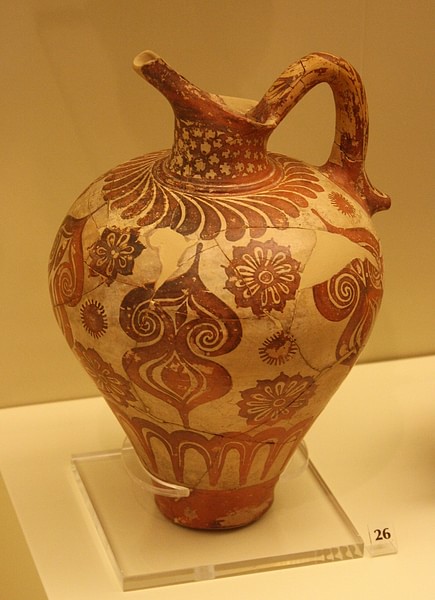
Mycenaean Jug
Popular Mycenaean vessel forms include stemmed cups, one-handled teacups, tankards and jugs with vertical strap handles and either spouts or cut-away necks. The near pop form was the stirrup jar, so chosen because the handle resembles a double stirrup. The middle of the handle was often busy to look similar a spout whereas the true spout was in fact to the side and divide from the handle. The second well-nigh popular vessel shape was the alabastron, a squat jar of diverse sizes, so named because the early examples were made from alabaster.
Clay sarcophagi had been widely used by the Minoans to bury their dead, and they ordinarily took the form of either a chest with brusque legs or a bathtub. They were decorated in much the same style every bit pottery vessels. Mycenaean Crete connected to produce them in corking numbers. Clay was also used to brand rhyta - vessels used for pouring libations and formalism drinking during religious ceremonies. These are most commonly in a conical form and are decorated as contemporary pottery vessels.
Like the Minoans, the Mycenaeans loved to paint ocean life, especially octopuses and nautiluses. Designs as well continued to make full all of the decorative surface and follow the contours of the vessel. Mycenaean pictorial scenes include chariots and human figures, something extremely rare in Minoan pottery. Sacral knots, double axes, and tusked helmets were pop subjects as were animals, birds, and griffins, often arranged heraldically and themselves decorated with pattern designs, possibly imitating contemporary textile designs. An excellent example of this technique tin can be seen in the balderdash and bird busy vase from the British Museum, where the bodies are divided into sections, each decorated differently with dots, wavy lines, scales, crosses, or chevrons.
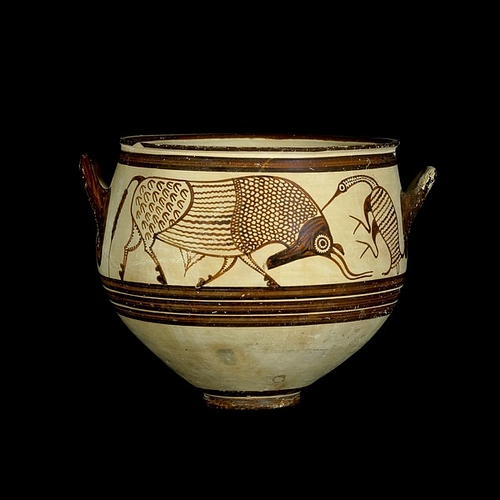
Mycenaean Vase Decorated With Bulls & Birds
Gradually, representations became more stylistic and more symmetrical with non all of the decorative space filled, leaving significant blanks, again, something rarely seen in Minoan pottery. Depictions of plants such as lilies, palms and ivy became more awe-inspiring, evolving into ordinarily employed motifs that were reserved principally for large jars. Designs on pottery eventually became and so abstruse that the original subject area becomes almost unrecognisable. Another development is a preference for only a single motif design on each side of the vessel and a marked increase in the space left bare. An excellent example is the Ephyrean goblet, a stemmed, two-handled cup from Mycenae, which is decorated with a single large rosette on each face.
The pottery of the Mycenaean civilization, then, achieved its own distinctive decorative way which was strikingly homogeneous beyond Mycenaean Hellenic republic. The Mycenaean fondness for stylized and minimalistic linear designs would go on to influence the early pottery of Archaic and Classical Greece from the 9th century BCE.
Mycenaean Frescoes
Mycenaean frescos which decorated palace walls and other buildings were similar to those of Minoan Crete, with nature and marine life again being the bailiwick of option. Mycenaean artists, every bit with potters, favoured a more than monumental effect and a greater preference for depicting religious ceremonies, processions, hunters and warriors. Unfortunately, examples of Mycenaean frescoes only survive in fragments. Those from Mycenae include a female effigy in profile wearing a tight-fitting jacket and holding possibly a necklace which is similar to the ane she is wearing. A fragmentary fresco with a very like discipline was discovered at Tiryns. Another surviving example from Mycenae is the fresco of the figure-of-eight shields, which has shields which appear to exist made of cow skin.
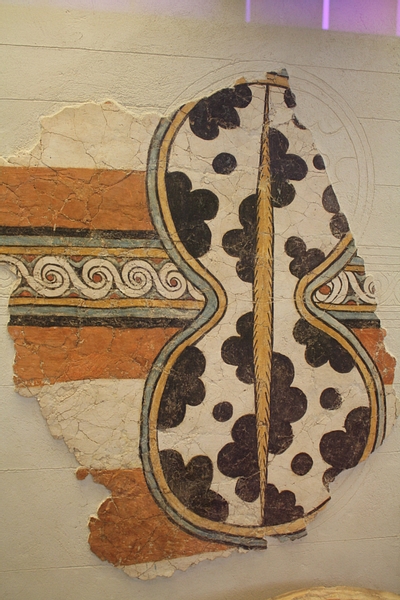
Shield Fresco, Mycenae
Mycenaean Sculpture
Clay figurines have been plant at sites across the Mycenaean empire, dating from the 14th to 12th centuries BCE and remarkably similar in design. Highly stylized to the point of being almost unrecognisable as human forms, the figures are near commonly female and continuing, probably representing a nature goddess. Oft these figures have ii arms raised or crossed in front end of the breast, a long skirt, and a conical headdress. They are only decorated with bold lines and sometimes jewellery is also painted on the figure using simple dots. From 1200 BCE clay animal figures, especially bovids, were also pop. Made on the wheel and with limbs and heads made by hand, they are as well simply busy with lines and dots. Figurines were also carved from os and probably forest (which has not survived).
Ivory boxes & panels to attach to article of furniture are more numerous & these often carry representations of sphinxes.
A head of possibly a sphinx in plaster with painted features is something of an enigma just, still, is firm evidence that Mycenaean artists were interested in sculpture fifty-fifty if few examples survive. It dates to the 13th century BCE and was discovered at Mycenae. Ivory figures are rare but an outstanding piece is the two goddesses and child figure group from Mycenae. Ivory boxes and panels to adhere to piece of furniture are more numerous, and these often acquit representations of sphinxes. Several limestone tomb markers take been excavated, and these are carved with relief designs typical of those found in other art works. I of the largest calibration pieces of Mycenaean sculpture is the famous panthera leo gate of Mycenae. Carved from limestone the pair of lions sit down either side of a column and date to c. 1250 BCE. They are an excellent example of a common feature of Mycenaean art: a Minoan subject (in this example ane seen in their seals) that is realised on a scale and in a form entirely Mycenaean.
Finally, and among the virtually impressive of all Mycenaean fine art works, there are the gold rhytons and decease masks. One of the finest examples of the quondam is that in the form of a lion's head now in the National Archaeological Museum of Athens. The death masks were placed over the confront of the deceased, and although not exactly portraits, they are each different. The most famous is undoubtedly the so-called 'Death Mask of Agamemnon' although, dating to the mid-16th century BCE, it is four centuries too early to be in the same time frame every bit Homer's male monarch of Mycenae.
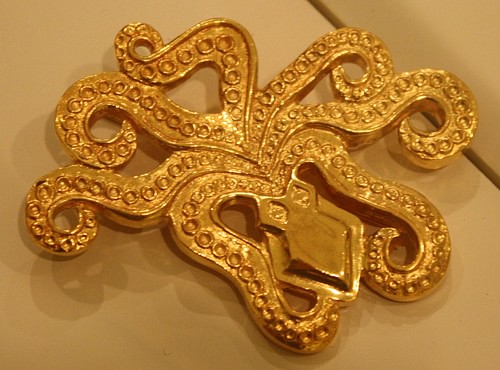
Mycenaean Octopus Brooch
Mycenaean Jewellery
Mycenaean jewellers used golden, glass, faience, precious and semi-precious stones (e.chiliad. carnelian, agate, and stone crystal), and amber to produce necklaces, pendants, rings, earrings, pins, brooches, and diadems. The full range of metalworking techniques was employed and fifty-fifty enamelling which the Minoans had non mastered. Glass beads were shaped, carved, and made from moulds.
Like the Minoans before them, Mycenaean artists became skillful engravers and created miniature masterpieces on rings and seals. Early on examples follow Minoan traditions of religious scenes and mythological creatures or hunting animals. Later examples testify the stylized flowers and plants seen in pottery decoration, and the class is different, small-scale squares of gilt existence typical. I of the finest rings is from Tiryns and shows a seated goddess being approached past a procession of four demon-like creatures bearing offerings.
Another medium for the engraver'due south fine art was the bronze blades of swords and daggers which bear witness scenes of mythology and hunting rendered in inlaid aureate and silver. Finally, fine gold work is exquisitely represented in several surviving gilded cups. The finest are 2 examples from Vapheio, busy with embossed scenes of men attempting to capture bulls. Both are in the National Archaeological Museum in Athens.
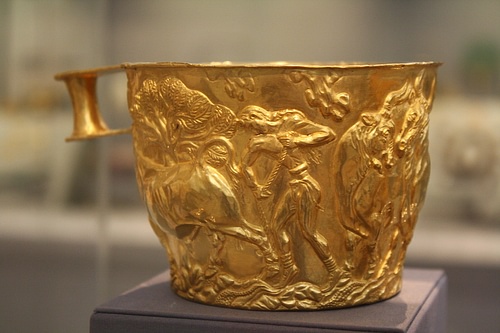
Vapheio Cup
Legacy
Mycenaean artistic influence is perhaps most tangible in its pottery which was exported and imitated not only throughout the Aegean but also in places as far afield as Anatolia, Syria, Arab republic of egypt, and Spain. There is also prove that Mycenaean potters actually relocated and set up workshops abroad, peculiarly in Anatolia and southern Italy. Indeed, information technology may well be that designs of a Mycenaean origin introduced into these areas lived on to exist reintroduced back to mainland Greece once the then-chosen Night Ages had concluded. The geometric pottery of the 8th century BCE certainly owed a great debt to the highly stylized pottery decoration so loved past the Mycenaeans. This, then, is possibly the greatest contribution the Mycenaeans made to Western art: they carried the torch of artistic endeavour, passing it from the Minoans to Primitive Greece then perpetuated the traditions which distinguished European art from the Eastward.
This article has been reviewed for accurateness, reliability and adherence to academic standards prior to publication.
pelletierthichise.blogspot.com
Source: https://www.worldhistory.org/Mycenaean_Art/
0 Response to "During the Mycenaean Period Largescale Figural Art on the Greek Mainland Was"
Post a Comment